Self-Care for New Dads: 7 Strategies That Actually Work

Introduction
Here’s a statistic that’ll knock your socks off: 8-10% of new fathers experience postpartum depression, yet up to 50% of men whose partners have postpartum depression will develop it themselves. Even more eye-opening? Up to 18% of new dads deal with clinically significant anxiety disorders in their baby’s first year according to recent research on perinatal depression.
I remember those early weeks after our little one arrived. I was running on fumes, living off cold pizza, and convinced that taking time for myself was somehow betraying my new role as a dad. Sound familiar? Here’s what I wish someone had told me back then: self-care for new dads isn’t selfish—it’s absolutely essential.
The reality is that effective self-care for new dads goes far beyond the occasional bubble bath or massage. Real self-care for new dads involves practical strategies that fit into the chaos of new parenthood while addressing the unique challenges fathers face during this transition.
Your mental health as a new father directly impacts your family’s wellbeing. When you’re overwhelmed, exhausted, and running on empty, everyone suffers. But when you prioritise your own wellness? You become the present, patient, and engaged dad your family needs. That’s not just feel-good advice—that’s science-backed truth that can transform your entire fatherhood journey. This connects closely to having the right new dad essentials that support both practical and emotional needs during this transition.
Why Self-Care for New Dads Matters More Than Ever
Let’s get real about something most people won’t tell you: father mental health is having a moment of crisis. Society still expects us to be these stoic providers who never crack under pressure. Meanwhile, we’re dealing with sleep deprivation that would make a Navy SEAL weep, hormonal changes (yes, men have them too!), and the crushing weight of keeping tiny humans alive.
The truth about self-care for new dads is that it’s not a luxury—it’s a necessity. When fathers neglect their own wellbeing, the entire family system suffers. Research consistently shows that self-care for new dads improves dramatically when fathers have access to peer support. The NHS approach to mental wellbeing comes down to five unglamorous things: staying connected to other people, moving your body, learning something, giving something, and paying attention to what’s around you. Not one of them costs money. All five get quietly abandoned in the first months of fatherhood, usually without anyone noticing — including you.
Paternal postpartum depression isn’t just “feeling a bit down.” It’s a legitimate medical condition that can manifest as irritability, withdrawal, anxiety, and that gnawing feeling that you’re failing at everything. The scary part? Many of us don’t even Recognise it because we’re so busy trying to be “strong.”
When I first became a dad, I thought mental wellness was something other people worried about. I was wrong—dead wrong. The research is crystal clear: new father stress doesn’t just affect you. It impacts your relationship with your partner, your ability to bond with your baby, and your child’s long-term development.

Breaking the “tough guy” stereotype isn’t just trendy—it’s necessary for survival. Your baby needs you healthy, present, and emotionally available for the next 18+ years. That starts with acknowledging that self-care for new dads is as important as changing nappies or midnight feedings.
Strategy 1: Master Quick Stress Management Techniques for New Dads
Alright, let’s talk about stress management for new fathers—and I’m not suggesting you meditate for an hour while your baby screams in the background! When it comes to self-care for new dads, effective stress relief needs to fit into the chaos of new parenthood.
The foundation of self-care for new dads starts with understanding that small, consistent actions often yield better results than grand gestures. Five-minute breathing exercises became my lifesaver. Here’s the deal: when you’re holding a crying baby at 3 AM and feel like you’re about to lose it, breathe — not dramatically, just deliberately. Let the breath go down into your belly, in gently through your nose for a count of five, then back out for a count of five. No holding, no forcing. Two minutes of that. It sounds ridiculously simple, but it activates your parasympathetic nervous system—fancy talk for hitting your body’s “chill out” button.
This simple breathing technique exemplifies what effective self-care for new dads should look like: quick, practical, and doable in any situation. The NHS calming breathing exercise is exactly this, and it works because slowing the out-breath is what tells your nervous system the emergency is over. It sounds too basic to be worth anything. That was my reaction too, right up until the night it wasn’t.
Progressive muscle relaxation during naptime was another game-changer. Start with your toes, tense them for 5 seconds, then release. Work your way up your body. By the time you reach your shoulders, you’ll feel like a different person. The beauty? You can do this lying on the couch while your little one snoozes.
Mindfulness apps designed for busy parents are pure gold. I’m talking about 3-5 minute sessions that fit between nappy changes. Apps like Headspace or Calm have specific programs for overwhelmed new fathers. Don’t have time for guided meditation? Try mindful nappy changing—focus entirely on the task, the textures, the sounds. It sounds weird, but it works.
Creating “reset moments” throughout your day is crucial for new dad mental health. Maybe it’s 30 seconds of deep breathing before walking through the front door after work. Or taking three conscious breaths before picking up your crying baby. These micro-moments of paternal mental wellness add up to massive stress reduction over time.
The key is consistency, not perfection. You don’t need to become a zen master overnight. You just need tools that work when the pressure’s on and the baby’s crying, and you haven’t slept more than two hours straight in weeks.
Strategy 2: prioritise Sleep Like Your Life Depends on It
Let me be brutally honest: new dad sleep deprivation nearly broke me. I was stumbling around like a zombie, making rookie mistakes, and snapping at people I love. Then someone told me something that changed everything: proper sleep is fundamental to self-care for new dads, and “sleep when the baby sleeps” isn’t just advice for moms.
Understanding sleep as a cornerstone of self-care for new dads helped me reframe rest as a necessity, not a luxury. Power napping techniques for exhausted dads are a real thing. Even 20 minutes can reset your entire day. Find a dark, cool space, set an alarm, and don’t feel guilty about it. Your brain literally repairs itself during sleep—you’re not being lazy, you’re performing maintenance on your most important tool.
The reality is that self-care for new dads requires us to protect our sleep like we protect our families. Creating an optimal sleep environment despite the chaos takes creativity. Blackout curtains became my best friend. White noise machines don’t just help babies—they help dads too. I started wearing earplugs on nights when my partner took the first shift, and it was revolutionary for my father mental health.
Managing sleep anxiety and racing thoughts was huge for me. Your brain loves to replay the day’s stress when your head hits the pillow. I started keeping a notepad beside my bed to write down worries—getting them out of my head and onto paper made all the difference. Sometimes the simplest self-care strategies for dads are the most powerful.

Here’s what nobody tells you about paternal stress management: sleep isn’t a luxury when you’re a new dad—it’s a necessity. You can’t pour from an empty cup, and you can’t be the father your family needs if you’re operating on fumes. Protect your sleep like you protect your baby, because in many ways, they’re equally important.
Strategy 3: Fuel Your Body for Maximum Energy
New dad nutrition was something I completely ignored in those early months. I was living off whatever was quickest and closest—usually cold leftovers eaten standing over the sink. Big mistake. Proper nutrition is a pillar of self-care for new dads that directly impacts energy levels, mood stability, and your ability to handle stress.
When we talk about self-care for new dads, nutrition often gets overlooked, yet it’s one of the most practical areas where fathers can make immediate improvements. Quick, nutritious meal prep became my secret weapon. Sunday afternoons, I’d spend an hour chopping vegetables, cooking grains, and preparing grab-and-go snacks. Mason jar salads, overnight oats, and pre-cooked proteins saved my sanity during those hectic weekdays. The key is making healthy choices easier than unhealthy ones.
Effective self-care for new dads means being strategic about nutrition rather than perfect.
Healthy snacking solutions that actually taste good are crucial for maintaining energy throughout those long days. I started keeping nuts, fruits, and protein bars in strategic locations—the car, my work bag, the nappy bag. When you’re dealing with overwhelmed new father syndrome, the last thing you need is a blood sugar crash.
Hydration hacks sound basic, but they’re game-changing. I bought a large water bottle and made it my mission to finish it twice daily. Dehydration amplifies every aspect of new father stress—headaches, fatigue, irritability. Proper hydration is one of the simplest father wellness strategies you can implement immediately.
Avoiding the caffeine crash trap required some strategy. Instead of chugging coffee all day, I learned to time my caffeine intake. One large cup in the morning, maybe a small one after lunch, then cut off by 2 PM to preserve whatever sleep I could get. Green tea became my afternoon companion—steady energy without the jitters.
Reading ingredient labels became second nature. If I couldn’t pronounce half the ingredients or it sounded like a “magical spell,” I avoided it. Whole foods became my go-to: fruits, vegetables, lean proteins, and complex carbohydrates. Your body will thank you, and your paternal mental health will improve dramatically.
The bottom line? You can’t run a marathon on junk food, and you can’t handle the marathon of new fatherhood without proper nutrition. Self-care for new dads includes treating your body like the high-performance machine it needs to be.
Strategy 4: Exercise Without a Gym Membership
Exercise for new fathers doesn’t mean spending two hours at the gym—because let’s face it, who has that kind of time? The beauty of self-care for new dads lies in finding creative ways to maintain fitness without sacrificing family time. I discovered that father fitness could happen anywhere, anytime, and still deliver massive mental health benefits.
The key to sustainable self-care for new dads is making exercise adaptable to your new reality. Fifteen-minute home workouts that really work became my salvation. Bodyweight exercises like push-ups, squats, lunges, and planks require zero equipment and can be done while your little one has tummy time. I created a simple circuit: 30 seconds work, 15 seconds rest, repeat for 15 minutes. It’s amazing how much you can accomplish in such a short time.
When designing self-care for new dads routines, baby-wearing exercise routines were a revelation. Strapping on the carrier and going for a brisk walk gave me cardio, fresh air, and bonding time all in one. Squats while holding your baby? That’s weighted resistance training! Before you know it, you’re getting stronger while your little one enjoys the motion.
The mental health benefits of movement for new fathers can’t be overstated. Exercise releases endorphins—nature’s mood boosters. It reduces cortisol levels, improves sleep quality, and gives you a sense of accomplishment. When everything feels chaotic, completing a workout provides structure and control.
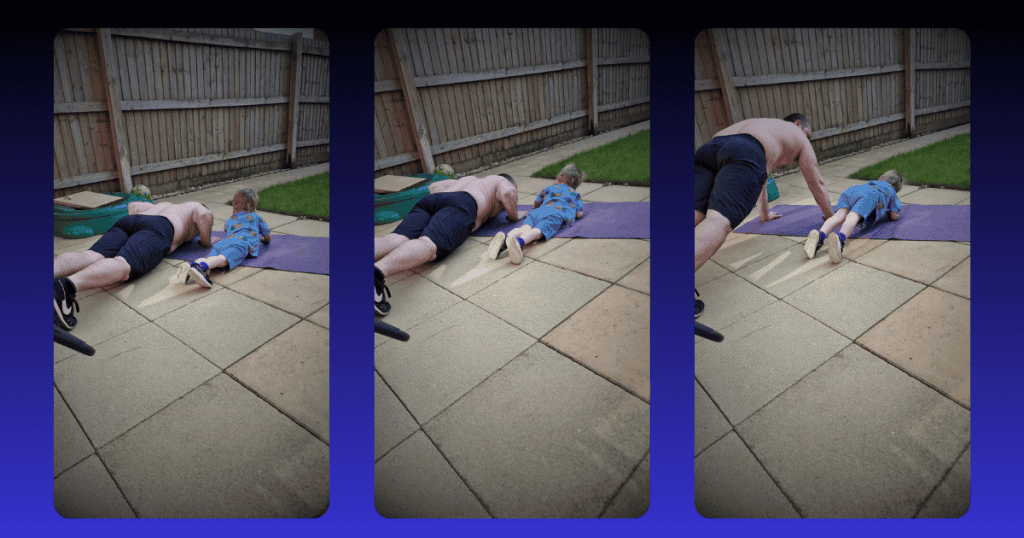
Finding motivation when exhausted requires reframing exercise as self-care, not punishment. I started viewing workouts as “me time”—15 minutes where I could focus solely on my body and breathing. Some days, it was the only time I felt truly present and in control.
Here’s something nobody mentions: every new dad should be able to do at least one pull-up. Not for ego, but for practical reasons—you might need that upper body strength to help your child someday. Plus, there’s something primal and empowering about being able to lift your own body weight.
OCR training (Obstacle Course Racing) became my personal passion. Whether it’s Spartan Race or Tough Mudder—I always find myself choosing between these two amazing challenges. There’s something about preparing for physical obstacles that parallels the obstacles of fatherhood. The training builds not just physical strength but mental resilience you’ll need as a dad.
Movement doesn’t have to be complicated. Take the stairs instead of the elevator. Park further away. Do calf raises while brushing your teeth. These small actions contribute to father wellness and demonstrate to yourself that your health matters.
Strategy 5: Build Your Support Network (Yes, Men Need This Too)
New dad support groups saved my sanity, and I’m not exaggerating. The isolation of early fatherhood hit me like a truck. Suddenly, my social life revolved around nappy changes and feeding schedules, and I felt completely alone in my struggles. Building a strong support network is perhaps the most overlooked aspect of self-care for new dads. In the UK, the PANDAS Foundation runs a support service specifically for dads — free, confidential, and staffed by trained volunteers who have heard it all before. They offer WhatsApp support and a callback you can book for a time that suits shift work, which matters more than it sounds when you cannot take a phone call between nine and five. Dad Matters and CALM cover similar ground. And if tonight is worse than that, Samaritans are on 116 123, free, round the clock.
The foundation of effective self-care for new dads includes recognising that you cannot and should not navigate fatherhood alone. Identifying your parenting support team starts with being honest about what you need. Your team might include your partner, parents, siblings, close friends, and other dads who’ve been through this journey. Don’t try to be a superhero—even Superman had the Justice League!
Research consistently shows that self-care for new dads improves dramatically when fathers have access to peer support. Joining new dad groups (online and offline) was initially intimidating for me. Men aren’t traditionally encouraged to seek emotional support, but these groups changed everything. Whether it’s a local meetup, an online forum, or even a group text with other new fathers, having people who understand your experience is invaluable for paternal mental wellness.
Having honest conversations with your partner about your mental health is crucial. I remember finally admitting to my wife that I was struggling with anxiety and feeling overwhelmed. Instead of judgment, I received understanding and support. We developed a system where we could openly communicate our needs without shame or guilt.
When and how to ask for professional help is something every new dad should know. If you’re experiencing persistent sadness, anxiety, irritability, or thoughts of harming yourself or others, reach out immediately. Mental health support for fathers is available, and seeking help is a sign of strength, not weakness.
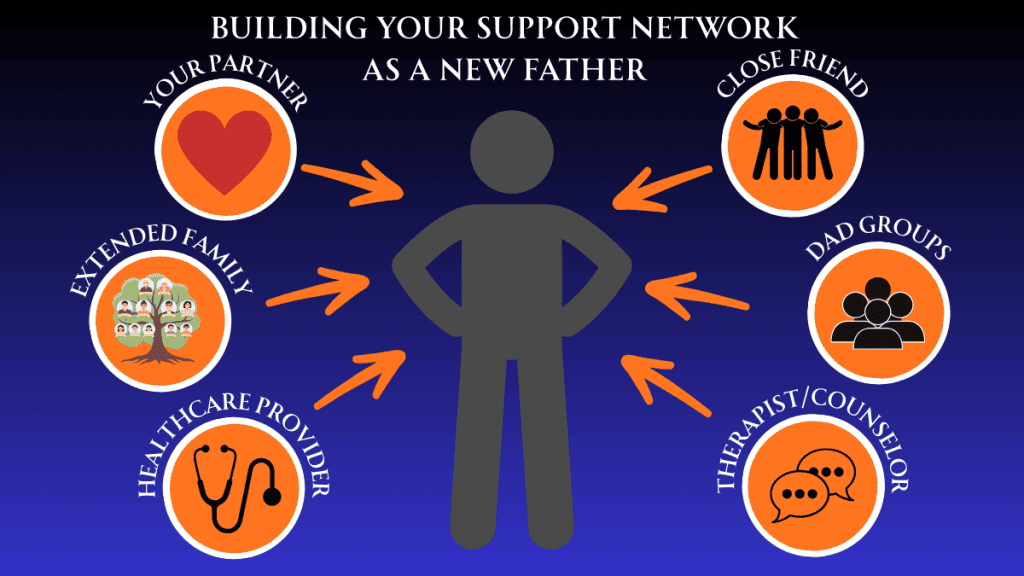
Father mental health resources are more accessible than ever. Many employers offer Employee Assistance Programs with free counseling. Online therapy platforms provide convenient access to mental health professionals. Local hospitals often have support groups specifically for new fathers.
The stigma around men seeking mental health help is slowly breaking down, but it still exists. Remember: your baby needs you healthy and present for decades to come. Taking care of your mental health isn’t selfish—it’s responsible parenting.
Building your support network takes effort, but it’s one of the most important self-care strategies for dads you can implement. You don’t have to navigate fatherhood alone, and you shouldn’t try to.
Strategy 6: Create Boundaries Between Work and Family
Work-life balance for new dads feels like trying to juggle flaming chainsaws while riding a unicycle. When I first returned to work after our baby arrived, I thought I could compartmentalize everything perfectly. Spoiler alert: I couldn’t, and trying nearly drove me to burnout. Establishing clear boundaries is essential for effective self-care for new dads.
The reality of modern fatherhood is that self-care for new dads often means being intentional about when you’re “on” versus when you’re “off.” Setting realistic expectations with employers became crucial for my father mental health. I had an honest conversation with my boss about my new responsibilities and how they might occasionally impact my availability. Most employers are more understanding than you’d expect, especially if you’re proactive about communication.
Self-care for new dads requires learning to protect your family time like a sacred ritual. Managing guilt about work-life balance was one of my biggest challenges. I felt guilty leaving work early for pediatric appointments, but I also felt guilty missing bedtime because of work commitments. Here’s what helped: remembering that being present for my family isn’t a luxury—it’s part of being a responsible father.
Technology boundaries for mental peace became non-negotiable. I established specific times when work emails were off-limits. After 7 PM and before 7 AM, my phone was in airplane mode. This simple boundary dramatically improved my paternal stress management and allowed me to be truly present with my family.
Protecting your family time like a sacred ritual requires intentionality. Sunday mornings became our protected family time—no work calls, no emails, no exceptions. These boundaries aren’t just good for new father wellness; they model healthy behaviour for your children as they grow.
Overwhelmed new father syndrome often stems from trying to excel at everything simultaneously. I learned to prioritise ruthlessly. Some projects at work had to wait. Some social obligations had to be declined. Self-care for new dads sometimes means saying no to good things so you can say yes to the most important things.
The financial pressure of having a new baby can make boundary-setting feel impossible, but remember: burning out doesn’t serve anyone. A sustainable pace benefits your career, your family, and your mental health in the long run.
Strategy 7: Rediscover Who You Are Beyond “Dad”
Maintaining personal interests as a new father felt impossible at first. I remember looking at my dusty guitar and thinking those days were over. But here’s what I learned: happy dad, happy child. When you maintain pieces of your identity beyond fatherhood, you become a more interesting, fulfilled, and present parent.
The importance of hobbies for fathers can’t be overstated. Research shows that engaging in hobbies reduces depression and anxiety while improving overall life satisfaction. For me, woodworking became my sanctuary. There’s something incredibly therapeutic about working with your hands, creating something tangible, and focusing your mind on precise measurements and cuts.
Woodworking benefits for mental health are backed by science. The craft engages multiple parts of your brain simultaneously—creativity, math, logic, spatial reasoning, and fine motor skills. It’s like meditation with a practical outcome. Plus, as your children grow, it becomes something you can share together.
My partner and I are currently preparing our garage workspace for woodworking projects. It’s exciting to think about teaching my son this valuable skill as he grows. Having a shared father-child hobby creates bonding opportunities and teaches important life skills about patience, precision, and problem-solving.
If you don’t have a hobby yet, explore different activities to find what resonates with you. Maybe it’s photography, cooking, reading, gardening, or learning a musical instrument. The key is finding something that brings you joy and allows you to express creativity or challenge yourself intellectually.
Connecting with friends outside of parenting talk is vital for father mental wellness. Schedule regular coffee dates, game nights, or activities with friends who knew you before you became a dad. These relationships remind you that you’re a complete person with interests, opinions, and experiences beyond nappy changes and feeding schedules.
Planning for your future self and goals keeps you motivated and forward-thinking. Maybe you want to run a marathon, learn a new skill, or start a side project. Having personal goals gives you something to work toward and maintains your sense of individual identity within the role of fatherhood.
Remember, self-care for new dads includes nurturing the parts of yourself that existed before your child arrived. Your baby will benefit from having a father who is fulfilled, interesting, and passionate about life—not just someone who only talks about baby milestones.
Here’s something I tell every new dad who says “my health doesn’t matter as long as my baby is healthy”: Super! That’s great for now, but will you be healthy enough to help your child in 10 years? Will you be able to play with your grandchildren in 20-30 years? Taking care of yourself today isn’t just about the present moment—it’s about being the strong, healthy father and grandfather your family will need for decades to come. Invest in your health now so you can be there for your family’s future.
Conclusion: Your Self-Care Journey Starts Today
Self-care for new dads isn’t a luxury—it’s a necessity that benefits your entire family. The statistics are clear: 8-10% of new fathers experience depression, and up to 18% deal with anxiety disorders in their baby’s first year. But here’s the empowering truth: you have more control over your mental health than you might think.
The journey of effective self-care for new dads begins with understanding that small, consistent actions create lasting change. These seven essential strategies aren’t just theoretical concepts—they’re practical, tested approaches that can transform your experience of fatherhood. Start small. Pick one strategy that resonates most with you right now. Maybe it’s the five-minute breathing technique, or perhaps it’s finally scheduling that overdue conversation with a friend.
Remember, paternal mental wellness is an investment in your family’s future. When fathers prioritise self-care for new dads principles, they model healthy behaviour for their children. You become more patient with your partner. You show up more fully in every aspect of your life. This ripple effect of positive change starts with your commitment to your own wellbeing.
Seeking help isn’t weakness—it’s wisdom. If you’re struggling with persistent anxiety, depression, or overwhelming stress, reach out to a mental health professional. Implementing self-care for new dads strategies works best when combined with professional support when needed. Your family needs you healthy and present for decades to come.
As I always tell fellow dads: think long-term. Your child will need you for at least the next 20-40 years. Every moment you invest in self-care for new dads practices today pays dividends for decades. Don’t sacrifice your health for present moments—your future self and your family will thank you.
Your journey as a father is just beginning. Make it sustainable, make it joyful, and most importantly, make it yours. The principles of self-care for new dads aren’t about perfection—they’re about progress. You’ve got this, dad.
What’s your biggest self-care challenge as a new father? Share your experiences and tips in the comments below—your insight could help another dad who’s struggling.
Frequently Asked Questions About Self-Care for New Dads
How much time should new dads realistically spend on self-care each day?
A: Start with just 15-20 minutes daily. This could be a quick workout, meditation, or hobby time. The key is consistency over duration. Even 5-minute breathing exercises or a brief walk can make a significant difference. As you establish routines, you can gradually increase the time when opportunities allow.
Is it normal for fathers to feel overwhelmed and anxious after having a baby?
Absolutely. Research shows that 8-10% of new fathers experience postpartum depression, and up to 18% deal with anxiety disorders in their baby’s first year. Feeling overwhelmed, stressed, or emotionally challenged is a normal response to the massive life change of becoming a parent. You’re not alone, and these feelings don’t make you a bad father.
When should new dads seek professional help for their mental health?
Seek help if you experience persistent sadness, anxiety, irritability, or thoughts of harming yourself or others for more than two weeks. Other warning signs include: loss of interest in activities you once enjoyed, significant sleep or appetite changes, difficulty bonding with your baby, or feeling completely overwhelmed most days. Don’t wait – early intervention leads to better outcomes.
Can exercise really help with mental health challenges in new fathers?
Yes, research consistently shows that regular exercise reduces symptoms of depression and anxiety while improving overall mood and energy levels. Exercise releases endorphins, reduces stress hormones like cortisol, and provides a healthy outlet for managing the pressures of new fatherhood. Even 15 minutes of daily movement can create noticeable improvements in mental wellbeing.
How do I find time for self-care when I can barely find time to shower?
Focus on “micro self-care” – small actions that fit into existing routines. Practice breathing exercises during your commute, do squats while your baby has tummy time, or listen to a podcast while washing dishes. Integrate self-care into family activities like going for walks with the baby or doing yoga while they play nearby. Quality matters more than quantity.