No WiFi Baby Monitor: Why DECT Beats WiFi Every Time in UK Homes (2026)

You spend £80 on a WiFi baby monitor. You set it up, you’re impressed — until you walk to the kitchen and the signal cuts out. You check the app. Buffering. You move closer. Still buffering. Meanwhile, your baby is upstairs and you’re staring at a frozen screen.
Some links on this page are affiliate links. If you buy through them, I earn a small commission at no extra cost to you. It doesn’t change what I recommend — you’ll notice I tell you which monitors to avoid, too.
If that sounds familiar, you’re not alone — and it’s not your router’s fault. It’s your house.
Most baby monitor guides are written for American homes. Open-plan, timber-frame, thin internal walls. UK homes — especially anything built before the 1980s — are a completely different animal. A no wifi baby monitor, specifically one using DECT technology, is often the only thing that actually works reliably in a British property.
This guide covers what DECT is, why it outperforms WiFi in British homes, what you give up by going without an app, and which no wifi baby monitor options are worth buying in the UK right now.
What Is a No WiFi Baby Monitor?
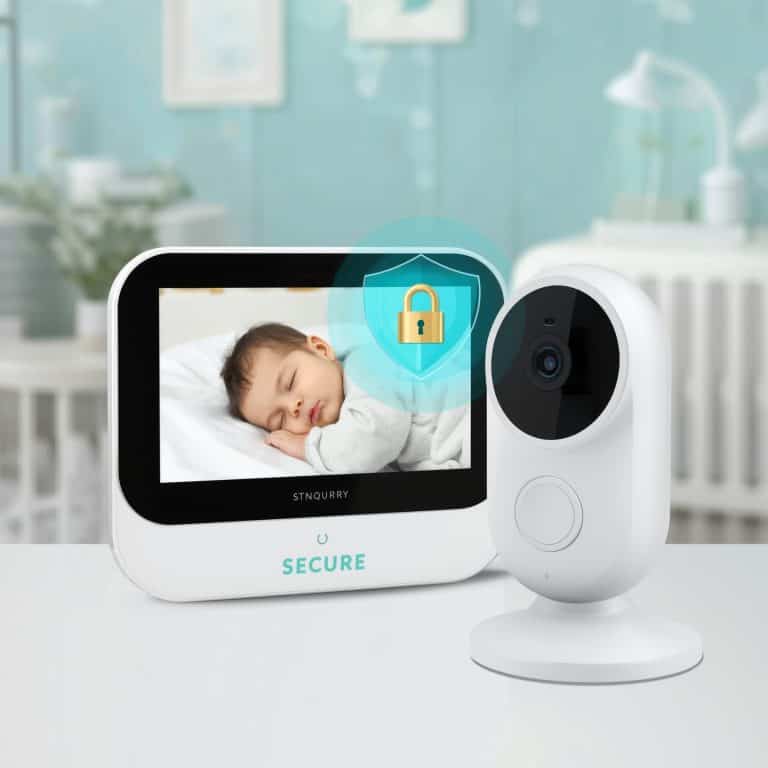
A no wifi baby monitor transmits audio and video directly between two units — a camera in your child’s room and a handheld parent unit — without needing your home broadband or a smartphone app.
No internet, no cloud, no subscription. Just a direct, private connection between you and your baby’s room.
The Two Main Types: DECT and Analogue
Not all no wifi baby monitor options are the same. There are two distinct technologies:
DECT (Digital Enhanced Cordless Telecommunications) operates on a dedicated 1.9GHz frequency band. It’s digital, encrypted, and interference-free. This is the technology that powers most modern cordless phones in the UK — which is why it works so well in British homes. DECT is what this guide is primarily about.
Analogue monitors are the older technology — the static-crackly ones your parents might remember. They still exist at the budget end of the market, but they’re unencrypted, easy to intercept, and prone to picking up interference from other devices. Unless budget is the only consideration, DECT is the better choice in every measurable way.
Why Most Guides Get This Wrong
The vast majority of baby monitor comparison articles online are written for a US audience. American homes are predominantly timber-frame construction with plasterboard internal walls. WiFi signals pass through them easily.
UK homes are not like this — and a no wifi baby monitor built around DECT technology is designed for exactly the kind of housing stock we actually live in.
Why WiFi Baby Monitors Struggle in UK Homes
The Victorian Wall Problem
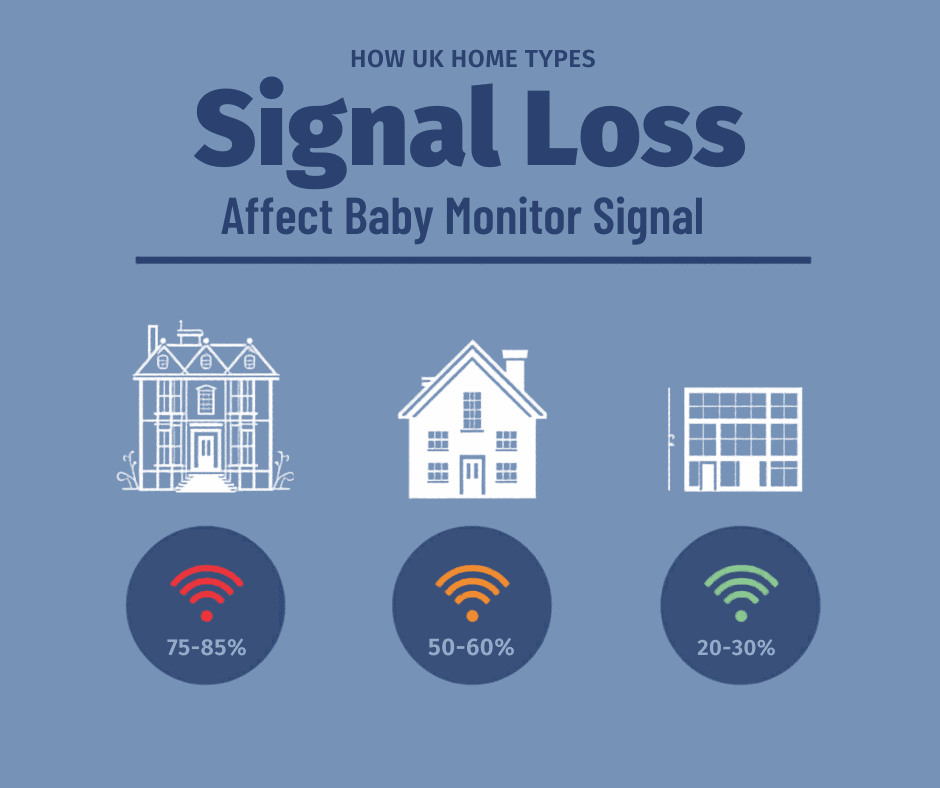
Roughly a third of UK housing stock was built before 1919. If you live in a Victorian or Edwardian terrace, semi-detached, or townhouse, your internal walls are likely solid brick — typically 9 to 12 inches thick.
A 2.4GHz WiFi signal loses significant strength passing through a single brick wall. Pass it through two or three on the way from the nursery to the kitchen, and you’re looking at a signal that drops, buffers, or disconnects entirely.
I learned this firsthand when helping a friend set up a WiFi monitor in his Victorian terrace in Bristol. The router was less than eight metres from the baby’s room. The signal barely made it to the landing. A no wifi baby monitor using DECT would have solved it immediately.
DECT operates on 1.9GHz. The lower the frequency, the better it penetrates dense materials. It’s not perfect through solid brick, but it’s significantly more reliable than WiFi at the same distance. For older UK homes, this difference is not marginal — it’s the difference between a monitor that works and one that doesn’t.
Neighbour Interference: The Hidden Signal Killer
Even in newer properties where walls aren’t the issue, UK urban environments create a different problem: WiFi congestion.
In a densely built area — a block of flats, a terrace row, a new-build estate — your monitor is competing for airspace with every router and smart device in surrounding homes. As Ofcom’s wireless interference guidance explains, 2.4GHz band overcrowding is one of the most common causes of unreliable wireless devices in the UK.
A no wifi baby monitor using DECT sidesteps this entirely. It uses a frequency band reserved for voice communications — separate from the crowded WiFi spectrum — so it’s genuinely interference-free regardless of how many networks your neighbours are running.
What Happens When Your Broadband Goes Down
WiFi monitors need internet. Not just your home network — many require cloud connectivity to function at all. If your broadband drops at 3am (which, in the UK, it occasionally does), your monitor goes with it.
A no wifi baby monitor doesn’t care about your broadband. It operates independently of your router and internet connection. The signal between camera and parent unit exists whether your fibre is working or not.
What Is DECT — and Why It Changes Everything
How DECT Works (Without the Jargon)
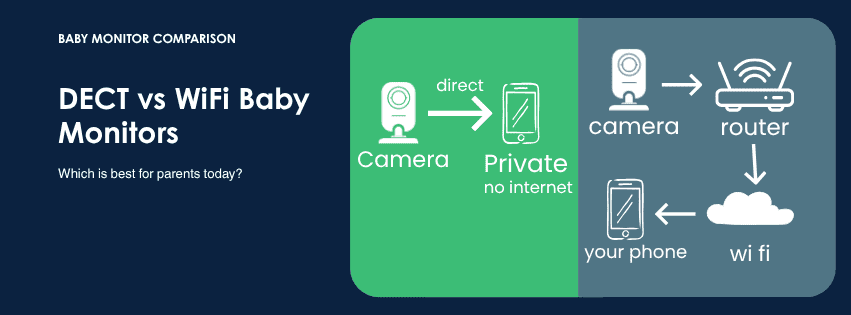
DECT creates a private, direct radio link between the camera unit and the parent unit. There’s no router involved, no cloud server, no app to log into. The two devices talk to each other — and only to each other.
The 1.9GHz band that DECT uses is allocated specifically for this purpose in the UK and Europe. It’s not shared with WiFi, Bluetooth, smart speakers, or anything else in your home. That dedicated allocation is why it’s so stable.
DECT vs WiFi: The Real Differences for UK Parents
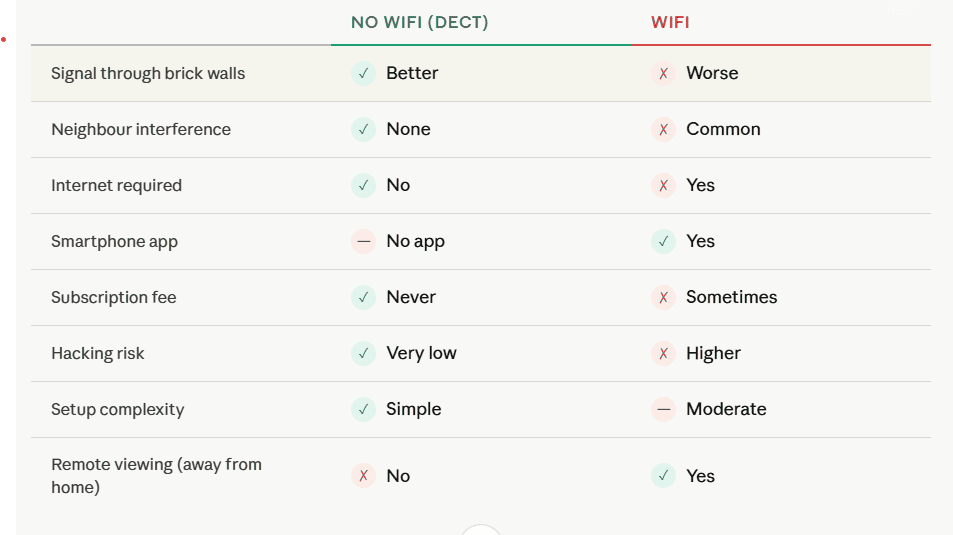
Is DECT Affected by Thick Walls?
Yes — but significantly less than WiFi. No radio signal passes through solid brick without some loss. The practical difference is that DECT maintains a stable, usable connection at distances and through materials that cause WiFi monitors to buffer or disconnect.
Most no wifi baby monitor options using DECT specify a range of 300-500 metres in open air. In a typical UK home with multiple walls, expect 50-100 metres of reliable coverage — more than sufficient for any standard house layout.
The Privacy Argument — Why No WiFi Means No Hackers
A no wifi baby monitor removes an entire category of security risk.
WiFi baby monitors connect to the internet. That means they’re accessible — in theory — from anywhere in the world, including by people who shouldn’t have access. Real incidents of baby monitor hacking aren’t hypothetical. Parents across the UK and US have reported strangers speaking through hacked monitors, unexplained camera movements, and private footage appearing online.
I’ve covered this in detail in our baby monitor security guide — including what the 2022 PSTI Act means for UK-sold devices and how to assess whether your current monitor is vulnerable.
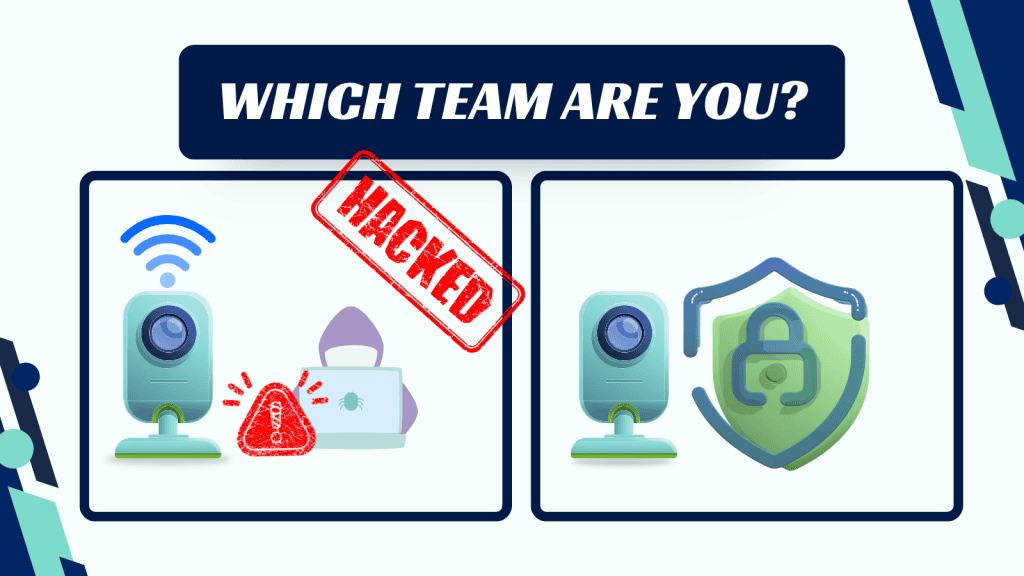
A no wifi baby monitor doesn’t connect to the internet. There’s no cloud server storing footage, no app login that could be compromised, no IP address for someone to probe. The only way to intercept a DECT signal is to be physically close with specialist equipment — a threat that, in practice, doesn’t apply to family homes.
This is why a no wifi baby monitor is the safer choice for UK families:
Do You Lose Anything Going No-WiFi?
Honest answer: yes, two things. Whether they matter depends entirely on how you live.
No App — Is That Really a Problem?
WiFi monitors let you view live video from your phone, including when you’re outside the house. If you regularly leave your baby with a partner or carer and want to check in remotely, you lose that with a no wifi baby monitor.
In our house, that’s not a scenario that applies. When I’m at work, my partner is home. When we’re both out, we use a babysitter we trust. Remote viewing sounds useful in theory — in practice, most parents use it rarely.
If you work irregular shifts and want to check in from work, that’s a genuine trade-off worth considering. For everyone else, it’s a feature that sounds better in the marketing than it functions in daily life.
No Remote Viewing: The Trade-Off Worth Making?
The parent unit that comes with a no wifi baby monitor has a dedicated screen — usually 3-5 inches — that shows live video whenever you’re within range. You carry it room to room. It’s always on, always connected, no loading screen.
There’s something to be said for a device that does one thing well. No notifications pulling you away, no draining your phone battery, no worrying about whether the app has updated itself and changed a setting you didn’t know about.
My honest assessment: the parent unit is more convenient for everyday use than an app. The app wins only when you’re outside the house.
Best No WiFi Baby Monitor Options for UK Homes 2026
For full detailed comparisons, see our best baby monitors UK guide. Here’s the short version for no wifi specifically:
Best Overall: Tommee Tippee Dreamee
British brand, proper DECT, and the most complete no-WiFi monitor you can actually buy in the UK right now. Solid range, clear audio, and a connection that holds through the brick walls that defeat cheaper alternatives. You get 360° pan-tilt, a cry sensor and a movement sensor mat, none of which need an app or an account. Available at Amazon UK, Currys and Superdrug.
Check the Tommee Tippee Dreamee on Amazon UK →
Best for: Most UK parents who want a reliable no wifi baby monitor without overspending.
Best Budget: VTech DM1211
The DM1211 is audio-only — but it’s rock solid, and it’s the cheapest thing here I’d actually recommend. DECT technology, good range, two-way talk, simple setup. If video isn’t a priority, this no wifi baby monitor covers everything that matters for a fraction of what you’d pay for a screen. It replaced the older DM221, which you’ll still see recommended in guides that haven’t been updated.
Check the VTech DM1211 on Amazon UK →
Best for: Budget-conscious parents, or those who find video more anxiety-inducing than helpful.
Best for Large or Older Homes: Philips Avent DECT Baby Monitor
The Philips Avent DECT range is consistently recommended for signal reliability in challenging UK properties. Better penetration through thick walls than most competitors, with a parent unit that maintains connection across larger floor plans. Widely available at John Lewis and Amazon UK.
Best for: Victorian terraces, larger houses, or anywhere WiFi signal has been a persistent problem.
What About BT? A Note on the Monitor Everyone Still Recommends
If you search for a no-WiFi baby monitor in Britain, you’ll be told to buy a BT. The BT 6000, the 450, the 750 — they’re on practically every UK buying guide, and for good reason. BT made genuinely excellent DECT monitors, and they were as British as this category gets.
BT has left the baby monitor market. The range is end-of-life, stock is whatever retailers have left on the shelf, and once it’s gone there’s no replacement coming. Nobody seems to have written this down, which is why guides published this year are still confidently recommending monitors you can’t reliably buy.
If you find a BT 6000 in stock at a sensible price, it’s still a good monitor — but check the warranty position before you commit, and don’t expect support from BT down the line. For a monitor you’re buying new today, the Tommee Tippee Dreamee above is the sensible British alternative.
No WiFi Baby Monitors and UK Regulations
The UK’s Product Security and Telecommunications Infrastructure (PSTI) Act 2022 introduced new legal requirements for internet-connected devices — mandatory unique passwords, published update policies, and a security contact point.
A no wifi baby monitor falls largely outside these requirements because it doesn’t connect to the internet. That’s not a loophole — it’s an accurate reflection of the fact that DECT devices present fundamentally different and significantly lower security risks than WiFi products.
For parents paying attention to IoT security news and wondering what the PSTI Act means for their current setup, choosing a no wifi baby monitor sidesteps the concern entirely.
FAQ
Is a no wifi baby monitor safe for babies? Yes. DECT operates at 1.9GHz with very low transmission power and is designed to minimise emissions during periods of no sound. It’s been the standard for cordless phones in UK homes for decades with no evidence of harm at these power levels.
What range does a no wifi baby monitor have? Most DECT models specify 300-500m in open air. In a typical UK home with multiple walls, expect 50-100m of reliable coverage — sufficient for virtually all standard house layouts including Victorian terraces.
Can I use a no wifi baby monitor in a flat? Yes — and DECT often works better in flats than WiFi. Flats typically have concrete floors and dense walls, and WiFi congestion from surrounding properties is common. DECT’s interference-free frequency handles both problems well.
Do no wifi baby monitors need internet? No. A no wifi baby monitor operates entirely independently of your broadband or router. It works whether your internet is on, off, or doesn’t exist.
What’s the difference between DECT and analogue monitors? DECT is digital and encrypted — the signal between camera and parent unit is private and secure. Analogue monitors are unencrypted and can be intercepted by other devices. DECT is the modern standard; analogue is legacy technology best avoided.
Conclusion
In a UK home — especially anything built before 1980 — a no wifi baby monitor isn’t a compromise. It’s the sensible choice.
DECT gives you a direct, encrypted, interference-free connection that doesn’t depend on your broadband, doesn’t create an internet-accessible camera in your child’s room, and doesn’t require a subscription or app update to function. It works in the houses we actually live in, through the walls we actually have.
What you give up is remote viewing. That’s a real trade-off. For most families — and certainly for ours — it’s one worth making.
If you’re still weighing up your options, our best baby monitors UK guide covers both DECT and WiFi models with honest assessments of which works where. And if security is your primary concern, our baby monitor security guide covers everything you need to know about keeping your family’s monitor safe.