Baby Room Temperature UK: What It Should Be and How to Get It Right
Heads up: some links in this post are affiliate links. If you buy through them, I earn a small commission at no extra cost to you. It doesn’t change what I write.
In our house, the warmest room is the one nobody needs warm. Our bedroom sits right above the boiler, the heating pipes run under the floor, and it feels like we’ve got underfloor heating we never paid for. The thermostat is in there too. My son’s room is in the opposite corner of the house, and it only gets properly warm if ours hits 26–27°C.
So when people ask what the right baby room temperature is, I get why the answer feels simple on paper and messy in real life. The number is easy. Getting that number in the room where your baby actually sleeps is the hard part.
Below I’ll give you the official UK range straight away, then the bits that actually help at 2am: how to check if your baby is too hot or cold, what to dress them in at each temperature, why one room in a British house can be several degrees colder than the rest, and what we’d buy to keep an eye on it.
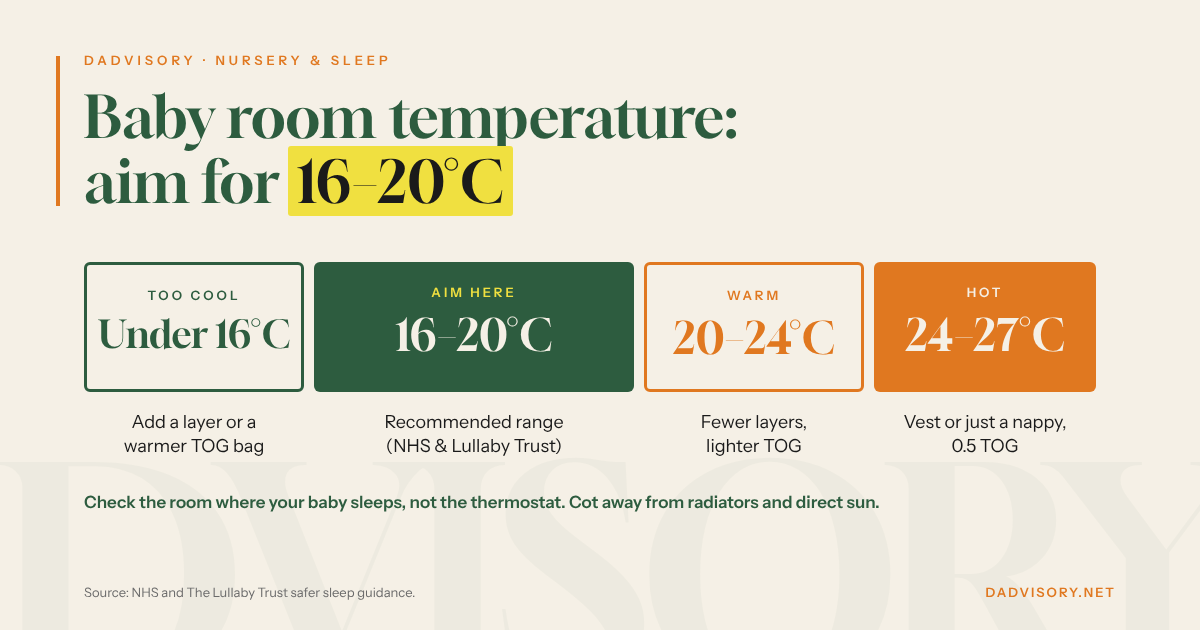
What Temperature Should a Baby’s Room Be? The Short Answer
16–20°C. That’s the baby room temperature both the NHS and The Lullaby Trust recommend for the room where your baby sleeps.
The reason it matters: the NHS lists letting a baby get too hot as one of the things to avoid to reduce the risk of sudden infant death syndrome (SIDS). The Lullaby Trust goes further and says babies are safer being a bit cooler than being too hot.
Two practical points come with that baby room temperature range. First, use a room thermometer, because you can’t feel the difference between 17°C and 21°C reliably, especially after a night shift. Second, the cot shouldn’t be next to a radiator, heater or fire, or in direct sunlight. Those are NHS rules, not mine.
If you’re setting up the whole room from scratch, the cot, mattress and bedding rules are all in my nursery safe sleep setup guide. This post zooms in on temperature only.
Our House: A Warm Boiler Bedroom and a Cold Corner
We live in a new build. You’d think that means even heat in every room. It doesn’t.
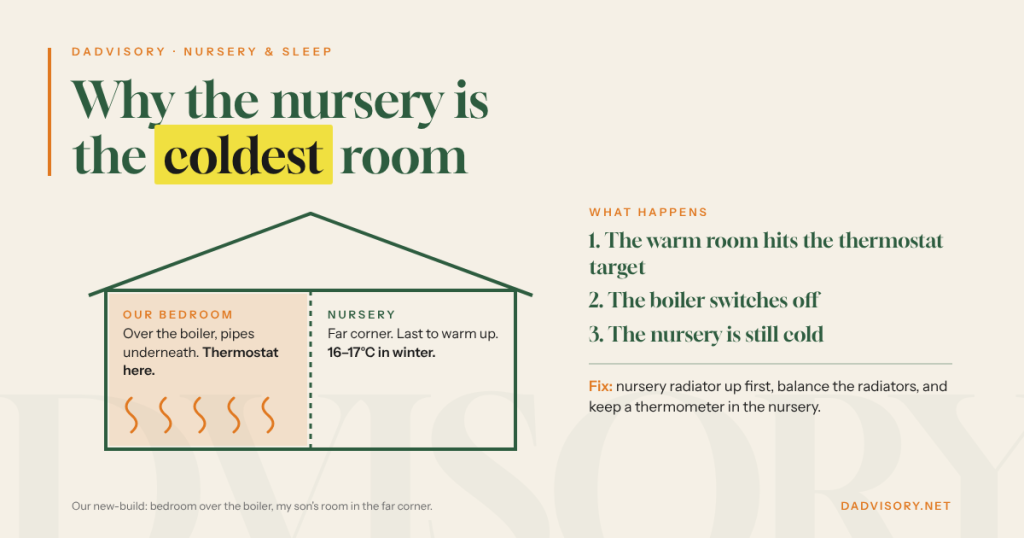
Our bedroom is over the boiler, with the pipes running underneath, so it warms up first and stays warm. The thermostat lives in that same room. That’s the problem in one sentence: the thermostat reads our warm room, decides the house is fine, and switches the heating off long before the far corner catches up.
My son’s room is that far corner. If I wanted his room at 20°C in January, our bedroom would have to sit at 26–27°C. Nobody sleeps well like that, and it makes no sense to heat the whole house to warm one room.
So his baby room temperature has always been on the cool side. When he was a baby he slept in a sleeping bag, and in winter that was a 2.5 TOG bag, if I remember right. The room was cool, not cold. Today he’s four, and in winter he sleeps in warm pyjamas under his bedding with the room at 16–17°C.
Cool is fine. Cold isn’t.
I’ll be honest about something. Part of our thinking back then was that a cooler room would help toughen him up. It’s not a reason any UK guidance gives, though. I wouldn’t sell it to you as one.
The real reason a cool room was fine is simpler. 16–17°C is inside the recommended baby room temperature range, and he was dressed for it. That’s the whole trick: the room sets the temperature, and the sleeping bag and layers do the work. A cool room with the right TOG is fine. A room below 16°C with a baby in a thin bag is not.
How to Tell If Your Baby Is Too Hot or Too Cold
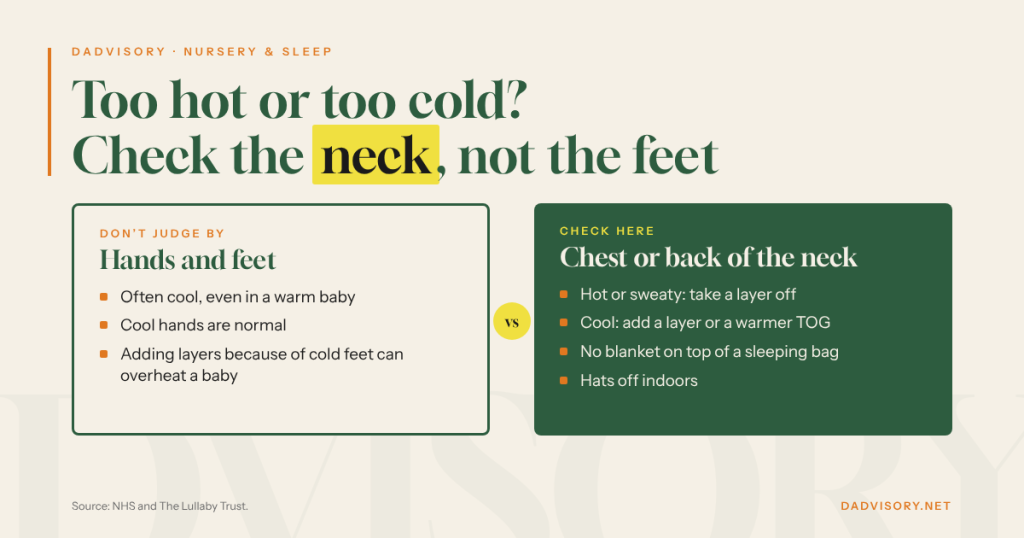
The thermometer tells you the baby room temperature. Your hand tells you how the baby is actually doing. You need both.
The NHS advice is to feel your baby’s chest or the back of their neck. Don’t go by hands or feet. Cool hands and feet are normal in babies, and judging by them is how a lot of us end up adding a layer the baby didn’t need.
- Hot or sweaty chest or neck: take off a layer of clothing or bedding.
- Chest or neck feels cool: add a layer of clothing or switch to a warmer TOG sleeping bag. Not a blanket on top of the bag.
- Hats off indoors. The NHS says to remove hats and extra layers as soon as you come inside or get into a car, bus or train, even if it wakes the baby.
What to Dress Your Baby In at Every Room Temperature
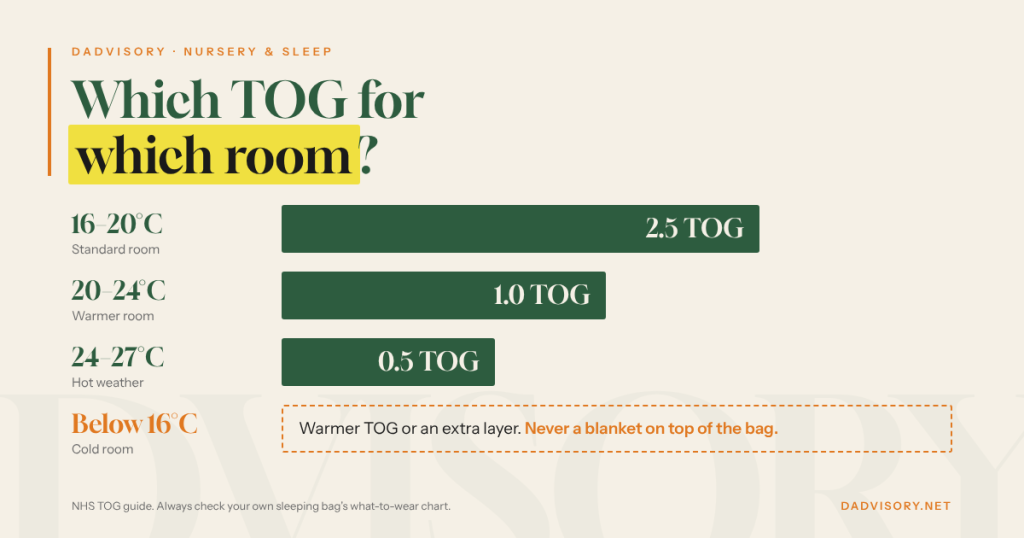
This is where the baby room temperature turns into a decision you make every night. The NHS gives a simple TOG guide for baby sleeping bags in its safer sleep advice:
| Room temperature | Sleeping bag (NHS guide) | Underneath |
|---|---|---|
| Below 16°C | Warmer TOG bag | Add an extra layer of clothing. No blankets on top of the bag (Lullaby Trust). |
| 16–20°C | 2.5 TOG | Follow your sleeping bag’s own what-to-wear guide. |
| 20–24°C | 1.0 TOG | Lighter layer, such as a short-sleeve vest. |
| 24–27°C | 0.5 TOG | A short-sleeve vest or just a nappy on the hottest nights. |
One important caveat. The Lullaby Trust deliberately doesn’t publish its own TOG chart, because every product is made differently and every baby is different. Their advice is to follow the manufacturer’s TOG guide for the sleeping bag you actually own. Treat the table above as the NHS starting point and the label in your bag as the final word.
A few rules from The Lullaby Trust that are easy to get wrong when you’re tired:
- Two 1.0 TOG bags don’t make a 2.0 TOG bag. Layering sleeping bags can be dangerous. If you need warmer, buy the right TOG.
- A blanket folded in half counts as two blankets. If you use a cellular blanket instead of a bag, tuck it in firmly, no higher than the shoulders.
- The bag has to fit. Most are sized by weight, not age, and should fit well around the neck and shoulders so your baby can’t slip down inside it.
- No weighted sleeping bags, swaddles or blankets for babies under one. The Lullaby Trust doesn’t recommend them because of the risk of overheating and head covering.
Is 22°C Too Hot? Is 15°C Too Cold? Baby Room Temperature Outside the Range
These are the two questions I see most, so here’s how I read the guidance.
When the room is above 20°C
22°C isn’t an emergency. It’s a warmer room, and the answer is fewer layers, not panic. The NHS guide puts 20–24°C in 1.0 TOG territory, and The Lullaby Trust says it’s fine for a baby to be in a short-sleeve bodysuit, or even just a nappy, when it’s warm. Then check the chest or neck.
You’ll also see 20–22°C quoted online as the “ideal” range. That figure usually comes from American sites, which work to different advice. For a UK baby, stick with the NHS and Lullaby Trust baby room temperature of 16–20°C.
When the room drops below 16°C
There’s no official “too cold” cut-off below 16°C. What the guidance does say is clear: add a layer of clothing or move up to a warmer TOG bag, and never put blankets on top of a sleeping bag.
In a Which? piece on keeping babies warm in winter, The Lullaby Trust suggests a 2.5 TOG bag with a vest and sleepsuit, or a 3.5 TOG with just a sleepsuit, for a room around 14–16°C. Below that, a 3.5 TOG with a vest and sleepsuit. If your nursery is regularly in single figures, that’s a heating problem to fix, not a clothing problem.
Why the Nursery Is Often the Coldest Room in a UK House
If your nursery is always a few degrees behind the rest of the house, you’re not imagining it. It’s usually one of three things, and in our house it’s all three.
- The thermostat is in the wrong room. A wall thermostat switches the boiler off when its room is warm. If it’s in a warm bedroom over the boiler, like ours, it switches off while the nursery is still cold.
- The nursery is the furthest radiator from the boiler. Radiators closest to the boiler get the hot water first. The far end of the system is often the last to warm up, and an unbalanced system makes that worse. Balancing radiators is a job a heating engineer can do, or you can do it yourself with the lockshield valves.
- The house itself. North-facing rooms, external walls and draughty windows all pull a room down. In old Victorian and Edwardian houses with solid brick, the nursery can be the coldest room by a long way. I wrote about what thick brick walls do in an old UK house in a different context, but the same walls hold the cold.
One thing worth knowing about thermostatic radiator valves (TRVs): the numbers on them aren’t degrees. A “3” isn’t 3°C or 30°C, and it means different things on different brands. The Energy Saving Trust suggests setting each valve to the lowest setting that keeps the room comfortable. The only way to know what a setting does in the nursery is a thermometer in the nursery.
Safe Ways to Get the Baby Room Temperature Right
Winter: getting a cold nursery into range
- Turn the nursery radiator up first, before you touch the main thermostat. Turning the whole house up to warm one room is what we’d have to do, and it’s the expensive way.
- Stop the draughts. Seal gaps around windows and doors, and use thick or thermal curtains at night. Which? also points out that cot bumpers are not a fix for draughts.
- Heating on overnight? If your home is cold enough that you want to leave it on, The Lullaby Trust says to keep it on a low setting and no higher than 20°C.
- Portable heaters: the Which? advice is to warm the room before bed, then switch the heater off and take it out once the baby is down. If you do use one in the room, The Lullaby Trust says to point it away from your baby.
- Never: hot water bottles or electric blankets for a baby, or a cot next to a radiator. Those are on the Lullaby Trust’s cold weather list for a reason.
Summer: keeping a hot nursery down
- Blinds and curtains closed during the day. We’ve had blackout blinds in since day one, and on hot days they keep the sun’s heat out as well as the light. If you’re choosing some, here’s my guide to blackout blinds for a nursery.
- Window and door open in the evening, if it’s safe to do so, to get air moving through.
- A fan is fine, as long as it isn’t pointed straight at your baby. That’s from the Lullaby Trust’s hot weather advice.
- Fewer layers. 0.5 TOG, a short-sleeve vest, or just a nappy on the hottest nights.
Do You Need a Thermometer to Check Baby Room Temperature?
Yes. It’s one of the cheapest things in the nursery and one of the most useful. The Lullaby Trust says to use a room thermometer in the rooms where your baby sleeps, because it’s hard to guess. In a house like ours, the reading in the hallway or our bedroom tells you nothing about the baby room temperature in his room.
What we used: a basic square digital thermometer with a hygrometer, so it showed humidity as well as temperature. Nothing fancy, and it did the job. We’re now thinking about a “weather station” style clock that shows the time, temperature and humidity on one screen.
Here’s how I’d choose, with the honest caveat that I haven’t tested any of the specific models below myself:
- Budget pick, closest to what we used: a small digital thermometer-hygrometer such as the ThermoPro TP49. Check today’s price on Amazon UK. Budget price, and it shows humidity too.
- For the nursery shelf: the Tommee Tippee GroEgg2. It changes colour with the temperature, and the colours match the TOG colours on Grobag sleeping bags, which is handy at 3am. It also works as a night light. It doesn’t measure humidity. Check today’s price.
- What we’re considering: a weather-station clock with indoor temperature and humidity. Lots of brands make them, mostly budget to mid-range. See options on Amazon UK.
- The cheapest option of all: The Lullaby Trust sells its own simple room thermometer card in its shop. No affiliate link there, and the money goes to the charity.
Already got a baby monitor with a temperature sensor? Use it, but know its limit. It reads the air where the camera sits, not where your baby lies, so a camera near a radiator or a cold outside wall will mislead you. I go into that in my post on where to put a baby monitor in the nursery.
A hygrometer is worth having for another reason too. Cold rooms in UK houses are often damp rooms, and condensation on the window in the morning is the first sign. Keeping an eye on humidity alongside the baby room temperature tells you if you’ve got a damp problem building before you see mould.
If Your Baby Is Unwell
This is the one time the instinct to wrap them up, or crank up the baby room temperature, is wrong. The Lullaby Trust says not to be tempted to wrap an unwell baby up more than usual, and the NHS says that even in winter, most babies who are unwell or feverish don’t need extra clothes.
If your baby has a fever or you’re worried, call your GP or NHS 111. If your baby seems seriously unwell, call 999. Don’t wait to see if a room temperature change fixes it.

Baby Room Temperature: Frequently Asked Questions
What temperature should a baby’s room be in the UK?
Between 16°C and 20°C. That’s the range recommended by both the NHS and The Lullaby Trust for the room your baby sleeps in. Babies are safer slightly cool than too hot, because overheating is a risk factor for sudden infant death. Check the baby room temperature with a thermometer in the nursery itself rather than relying on your thermostat or how the room feels to you.
Is 22 degrees too hot for a baby’s room?
It’s above the recommended 16–20°C, but it doesn’t mean your baby is in danger. It means fewer layers. The NHS guide suggests a 1.0 TOG sleeping bag for rooms of 20–24°C, and a short-sleeve vest underneath is usually enough. Feel your baby’s chest or the back of the neck, and remove a layer if it feels hot or sweaty.
Is 16 degrees too cold for a baby?
No. 16°C is the bottom of the recommended range, so it’s fine as long as your baby is dressed for it. In our house my son’s room has always sat around 16–17°C in winter. The NHS guide puts 16–20°C in 2.5 TOG territory. If the room drops below 16°C, add a layer of clothing or use a warmer TOG bag, never a blanket on top.
Should I leave the heating on overnight for my baby?
Usually you don’t need to, if the room stays in range and your baby is dressed for it. If your home gets cold enough at night that you want the heating on, The Lullaby Trust says to keep it on a low setting and no higher than 20°C. Check the nursery with a thermometer, because the thermostat may be in a much warmer room.
How do I know if my baby is too hot at night?
Feel their chest or the back of their neck. If it’s hot or sweaty, take off a layer of clothing or bedding. Don’t judge by hands and feet, because they’re often cool even when a baby is warm enough. Hats should come off indoors, and the cot shouldn’t be next to a radiator.
My Verdict
The baby room temperature to aim for is 16–20°C. Getting there is about the room your baby actually sleeps in, not the number on your thermostat.
If you take one thing from this post, put a cheap thermometer in the nursery tonight and see what your real baby room temperature is. If the room reads 16–17°C like my son’s, you don’t need to heat the house to tropical levels. Dress your baby for the room, check the chest or neck, and leave it. If it reads below 16°C, fix the draughts and the radiator first, then the TOG.
Temperature is one part of a safe nursery. For the rest, the cot, the mattress, the bedding and the printable checklist I put together, head to my full guide to setting up a safe nursery.
This post is a dad’s experience plus official UK guidance, not medical advice. For safe sleep, always follow the NHS and The Lullaby Trust, and speak to your health visitor, GP or NHS 111 if you’re worried about your baby.