Baby Monitor Placement: Where It Goes in the Nursery (and the One Rule That Matters)
When we set up my son’s nursery, the monitor was the last thing I thought about and the first thing I got wrong. I clipped the camera to the cot rail because that’s how it looked in the box photos. It took my wife about four seconds to point at the dangling power cable and ask the obvious question. She was right. I moved it that night.
So let’s get baby monitor placement right the first time, because this isn’t only about a sharp picture. Get the position wrong and a great camera angle becomes a genuine hazard. Get it right and you’ve got a clear view, a stable signal, and a cot your child can’t turn into a problem. Here’s exactly where the monitor goes, how high, how far, and the cord rule I wish someone had told me before I started drilling.
Where to place the camera for the best view
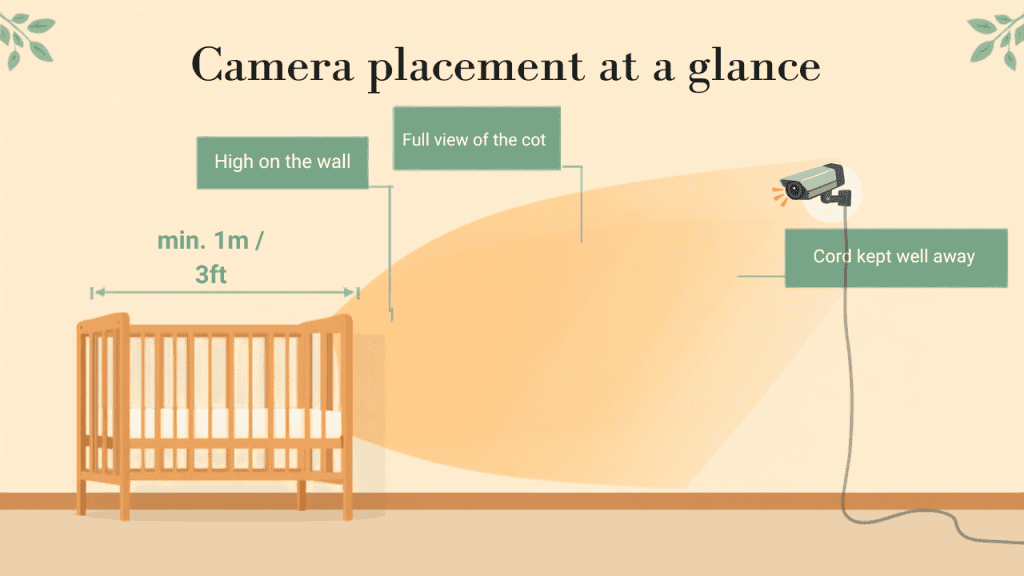
You want the whole cot in frame — your child’s head and chest, end to end — not a tight crop of one corner. The best angle is from above and slightly to the side, looking down into the cot rather than straight across it. A diagonal view from a high corner of the room usually nails it.
Two things wreck the picture more than anything. First, backlight: if the camera faces a window with the cot in front of it, daylight floods the lens and your baby becomes a dark silhouette. Position the camera so the window is behind it or off to one side. (As it happens, you shouldn’t have the cot under a window anyway — more on that in the cord section.) Second, reflective surfaces at night. Infrared night vision bounces off mirrors, glossy wardrobes and glass, so avoid pointing the lens at anything shiny.
If your monitor has a built-in temperature sensor, remember it reads the air where the camera sits, not where your baby lies. Mount it too near a radiator or a cold external wall and the number lies to you. Worth knowing if you’re trying to hold the right room temperature for a baby.
How high and how far from the cot
Height does two jobs at once. High up gives you the full-frame view down into the cot — and it puts the unit and its cable out of reach. Wall height, near the ceiling or on a tall shelf, is the sweet spot.
Distance matters for focus too. Most video monitors are designed to see clearly from across the room, not from 20cm away, so jamming the camera right up against the bars actually gives you a worse, blurrier image. Pull it back. Better picture, safer setup — which brings us to the part that actually matters.
Cord safety — the rule that matters
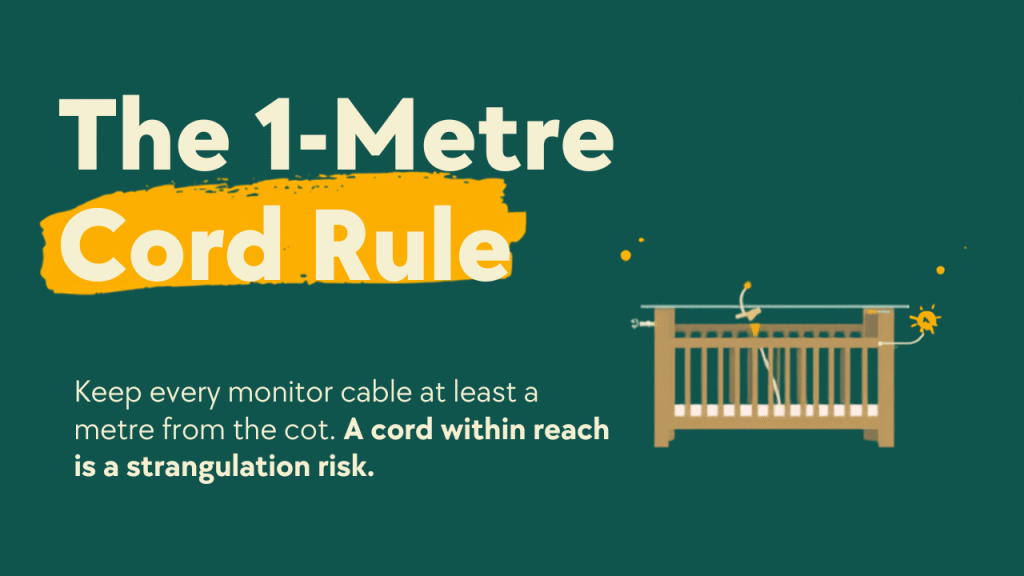
Here’s the one rule, and if you take nothing else from this guide, take this: keep the monitor and every cable at least 1 metre (about 3 feet) away from any part of the cot — and out of reach. Not draped over the rail. Not “tucked behind” the mattress. Not inside the cot. A metre, minimum, with the cord run flat to the wall and secured.
This isn’t me being precious. The US Consumer Product Safety Commission has documented child deaths and near-suffocations caused by baby monitor power cords, and the safe-distance guidance from bodies like the JPMA and the Baby Safety Foundation is consistent: at least three feet from the cot, never inside it, never on the edge of it. A cable within reach is a strangulation risk, full stop.
And here’s the bit people miss — what’s safe today isn’t safe in six months. A newborn can’t reach anything. A pulling-up nine-month-old has arms longer than you’d believe and a talent for grabbing exactly what they shouldn’t. Set the distance for the child your baby is about to become, not the one in the cot tonight, and re-check it every time they hit a new stage.
This dovetails with the single most important safer-sleep principle in the UK. The Lullaby Trust’s advice is blunt: the safest cot is a clear cot. Their guidance is that a baby needs only two things in there — a firm, flat, waterproof mattress and lightweight bedding — and that anything else, cords included, comes out. A monitor cable absolutely counts as “anything else.”
The same logic extends past the monitor to your window coverings, which is why RoSPA’s strangulation guidance says plainly: don’t place a cot, bed or playpen near a window, and keep curtain and blind cords short and out of reach using cleats, clips or cord tidies. Never cut a blind cord — it doesn’t make it safe, it makes the blind dangerous. This matters more than most parents realise: blind cords have killed at least 28 children in the UK since 1999. Since February 2014, all internal blinds sold here must meet the British safety standard BS EN 13120, mandated under the General Product Safety Regulations 2005 and enforced by Trading Standards — but older blinds in older homes often predate it. If you’re sorting the windows out properly, my guide to blackout blinds for the nursery covers the safe, cordless options.
Wall-mount vs shelf — and why never the cot
A wall mount is the cleanest answer. It gets the camera high, fixes the angle, holds it steady, and lets you run the cable straight down the wall and away from the cot. Most monitors come with a basic bracket; if yours didn’t, an inexpensive dedicated wall mount or shelf bracket is one of the few accessories actually worth buying.
A shelf works fine too, as long as it’s more than a metre from the cot and the cable is secured so it can’t be tugged or fall. What you should never do is attach the monitor to the cot itself. I know the box photos make it look neat. But it puts the cable inside the danger zone, and a camera clamped to a rail can be knocked loose and drop into the cot. The cot is for sleeping. The monitor lives on the wall.
Baby monitor placement in awkward UK rooms
British nurseries are rarely the airy box you see in American setup videos. A lot of us are working with the box room — the smallest bedroom, barely wider than the cot. In a tight room, take the angle from a high corner; a corner gives you the longest diagonal and the most distance you’ve got. In a room with a bay window, watch the backlight and keep the cot off the bay wall.
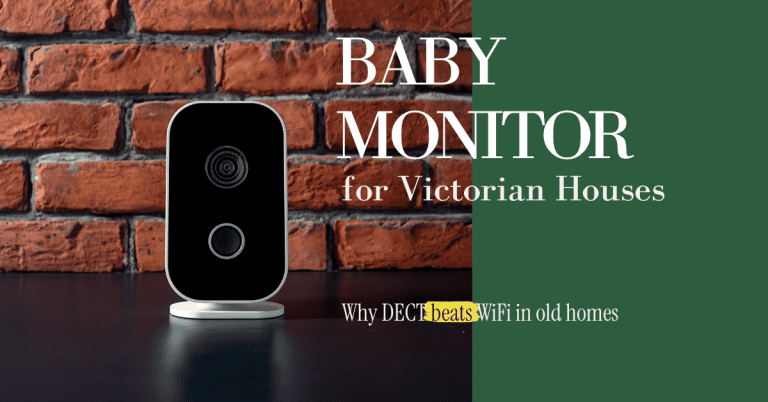
Then there’s the British brick problem. If you’re in a Victorian or Edwardian terrace, your internal walls can be solid brick rather than stud, and that murders a wireless signal between camera and parent unit. Placement can only do so much against 23cm of Victorian brick — at some point the kit itself has to be right for the building. I’ve covered exactly that in baby monitors for Victorian houses, and the case for going no-WiFi with a DECT monitor when thick walls are the issue. For the wiring and pairing side, the full set-up walkthrough takes it step by step.
Two cameras, two rooms, and siblings
If you’ve got two under the same roof, you don’t need two separate systems. Plenty of monitors are expandable — one parent unit, a second camera you add for the sibling’s room or to cover a big nursery from two angles. Whichever way you go, the rules don’t change per room: full view of the cot, camera high and out of reach, every cable a metre clear. Apply the same discipline in room two as room one. And it’s worth a thought about how long you’ll keep the second unit running at all — I get into that in when to stop using a baby monitor.
For the wider picture — choosing the monitor in the first place, and keeping it secure once it’s up — start with my guide to the best baby monitors in the UK and the baby monitor security guide. And if you’re still building the room out, the safe nursery setup guide puts all of this in context.

FAQ
Where should I put a baby monitor? High on a wall or shelf, angled down into the cot for a full view, at least 1 metre (3 feet) from the cot, with the cable run flat to the wall and out of reach. Keep it off any window wall to avoid backlight.
How far should a baby monitor be from the cot? At least 1 metre — roughly three feet — from any part of the cot. This is the widely accepted safe distance to keep the power cord out of reach. Re-check it as your child grows, because their reach grows with them.
Are baby monitor cords dangerous? Yes. A power cord within a child’s reach is a strangulation hazard, and there are documented deaths linked to baby monitor cords. Keep every cable a metre from the cot, never inside it, and never clipped to the rail.
Can you attach a baby monitor to the cot? No. It puts the cable in the danger zone and an unstable camera can fall into the cot. Mount it to the wall instead.
The whole job comes down to one habit: every cable a metre from the cot, and the cot kept clear. Sort the position once, then walk back into that room every few weeks and look at it through your crawling, climbing, grabbing child’s eyes. That’s the check that keeps it safe.