VTech VM819 Review: A UK Dad’s Verdict (and Why It’s Called VM3250 Here)
Affiliate disclosure: Some links below are affiliate links. If you buy through them, I earn a small commission from Amazon Associates and other partners — at no extra cost to you. I don’t get paid to say nice things. I bought into the “no WiFi” idea with my own money and my own reasons, and I’ll tell you exactly where this monitor falls short.
I don’t like clutter. Not in the garage, not in the nursery, not in my life. When my son was born, half the baby gear we were sold felt like it existed to solve a problem we didn’t have — apps, subscriptions, cloud accounts, a phone notification for every hiccup. So when people ask me about the VTech VM819, I get why. It’s the monitor that promises to do one job and skip the nonsense: no WiFi, no app, no monthly fee. For around £60, that’s a rare thing.
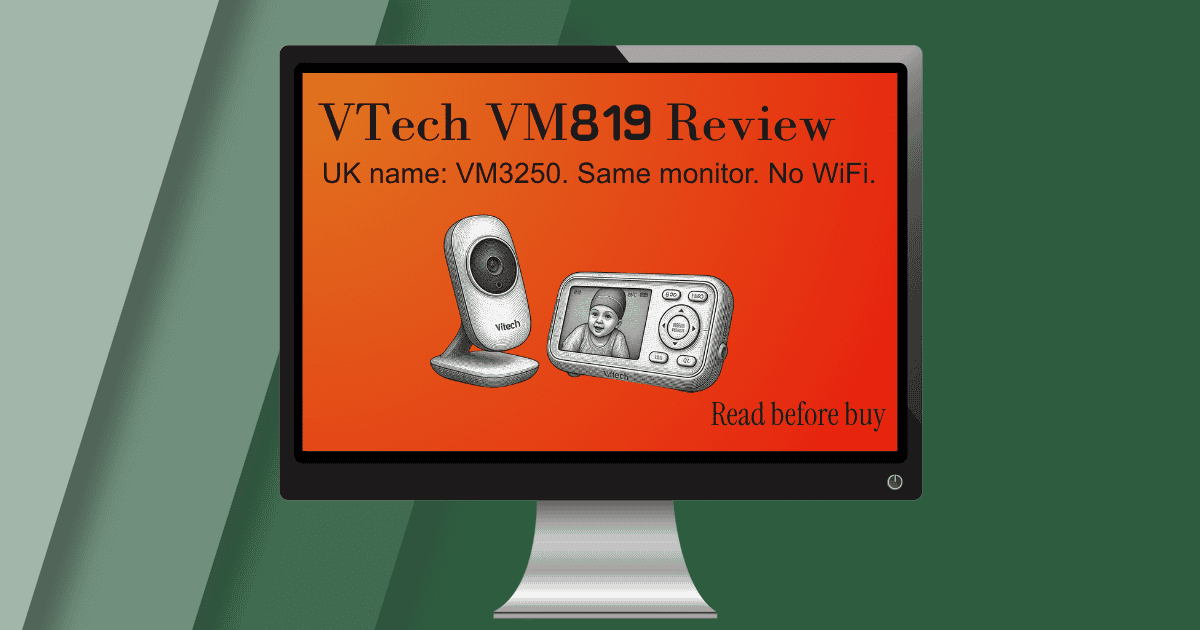
But here’s the first thing you need to know, and almost no VTech VM819 review will tell you: if you’re shopping in the UK, you won’t actually find a VM819 on the shelf. You’ll find the VM3250 — and it’s the same monitor. I’ll explain the naming mess in a minute, because it matters for what you pay and where you buy.
My honest verdict, up front: this is the budget king without WiFi — but it is not for every house, and right now there’s one pricing twist that complicates the decision. Let me show you exactly who should buy it, who should walk away, and which version to put in your basket.
The Quick Verdict
What it is: A no-frills, no-WiFi video baby monitor with a 2.8-inch colour screen and the best claimed battery life in its class. Sold as the VM819 in the US and the VM3250 in the UK — same monitor, different sticker.
VTech VM3250 Baby Monitor (VM819)

My VTech VM819 review for UK parents: why it's sold as the VM3250 here, the real battery story, and when the twin-camera VM3250-2 is the smarter buy.
Product Brand: VTech
Product Currency: GBP
Product Price: 59.99
Product In-Stock: InStock
4
Who it’s for: Parents on a tight budget in a flat or a newer-build house, who want to plug it in, see their baby, and never think about hackers, apps or subscriptions again.
Who it’s not for: Anyone in a Victorian or Edwardian house with thick solid brick walls (you want DECT — more on that below), anyone who needs a big screen, and anyone who wants to pan and tilt the camera from the sofa.
Price and availability: Amazon UK sells both versions directly — the single-camera VM3250 and the twin-camera VM3250-2. Here’s the odd bit: when I last checked in September 2026, the twin-camera set was cheaper than the single. Yes, you read that right — two cameras for less than one. The prices on these two swap places regularly, so check both before you buy.
The one complication: As I write this, VTech’s own VM924 — bigger 5-inch screen, motorised pan and tilt — is on a limited-time deal at £50.99. If that deal is still live when you read this, it changes the maths. I’ll deal with it honestly in the comparison section.
Where to buy: Amazon UK (as the VM3250) — currently the only place I can confirm it in stock. At the time of writing, it’s not stocked in the standard range at Boots, Argos, Tesco or Currys — despite what some older comparison sites suggest, so don’t plan a trip around it. If you see a “VM819” listing on Amazon UK, check it carefully — it’s usually an import.
VM819 vs VM3250 — Which One Can You Actually Buy in the UK?
Here’s the naming mess, sorted once and for all.
The VM819 is the model number VTech uses in the United States. It’s the name you’ll see in American reviews, YouTube videos and Reddit threads — which is probably how you ended up searching for it. The VM3250 is the same monitor for the UK and European market: 2.8-inch colour LCD, 300m open-air range, up to 19 hours of video streaming on battery, automatic night vision, temperature sensor, two-way talk, 2x zoom, soothing sounds, secured no-WiFi transmission. Line the spec sheets up side by side and they match.
Type “VTech VM819” into Amazon UK and the site quietly serves you the VM3250 listing. That’s not a bait-and-switch — it’s Amazon knowing they’re the same product. The practical upshot: buy the VM3250 and you’ve bought the VM819. You also get a UK three-pin plug, UK warranty support and UK returns, which brings me to a warning.
There is a two-camera American bundle called the VM819-2 floating around Amazon UK as an import listing — and buyers have reported it arriving with US plugs. You don’t need it. The UK equivalent is the VM3250-2, sold with proper UK plugs, and at the time of writing it’s £54.49 — less than the single-camera version. If you’ve got two kids in separate rooms, or you want a camera downstairs for the playpen years, the VM3250-2 is quietly one of the best-value monitor deals in the UK right now. One verified UK owner reported using the twin-camera set for nearly four years across two children’s rooms with no WiFi, no subscription and no trouble — his summary was “cheap and cheerful,” and after everything I’ve dug into, I can’t argue with it.
For the rest of this review I’ll say “VM819” because that’s what you searched for — but every buying link points at the VM3250, because that’s what you can actually get.
What You Get for £60
Let’s be clear-eyed about this. At £59.99 you are not buying a premium monitor. You’re buying a specific set of trade-offs, and for the right family they’re the right trade-offs. Here’s what’s actually in the box and what it’s like to live with.
Screen and Video Quality
The parent unit has a 2.8-inch colour LCD. The camera shoots at VGA resolution, and the picture is — I’ll be honest — sufficient, not impressive. In daylight it’s decent. You can see your baby breathing, rolling, sitting up. That’s the job, and it does the job.
But I won’t pretend it’s sharp. Independent testers at BabyGearLab, who buy their own units and take no freebies, rated the video quality as mediocre, describing a faint cross-hatch texture over the image and a bright spot in the centre of the night-vision picture that washes out detail. That matches what UK owners describe too. Night vision is automatic and infrared — no red glow to wake the baby — and it’s fine for checking movement, but don’t expect to count eyelashes.
Here’s the honest framing: a baby monitor’s video only needs to answer one question at 3am — is my child okay? The VM819 answers that. It will not give you a crisp, cinematic feed. If picture quality is the thing you care about most, this isn’t your monitor, and no amount of me being reasonable about the price will change that.
The 19-Hour Battery — the Star With an Asterisk
This is where the VM819 stops being “cheap and cheerful” and starts being genuinely class-leading — on paper, and mostly in practice. VTech quotes up to 19 hours of video streaming or 29 hours of audio-only from the 2,600mAh battery, and independent testing has consistently put it at the top of its field for battery endurance. A monitor that dies at 2am is worse than no monitor — it lulls you into trusting it, then goes dark. With most video monitors you’re tethered to the charger overnight. With a new VM819, you genuinely aren’t.
Now the asterisk, because you deserve the whole picture. Dig into the verified UK reviews on the VM3250 listing and a pattern emerges: some owners report the battery holding up beautifully, while others — including one reviewer this spring who otherwise rated it four stars — say battery life degraded to the point where the parent unit effectively lives on its charger. Amazon’s own summary of customer feedback says the same: battery life and reliability get genuinely mixed reports, with some units degrading faster than others. A few owners also mention a faint clicking or popping sound from the unit while it charges.
My reading, as someone who’s taken apart enough battery-powered kit in the garage: the 19-hour figure is real for a new unit, but this is a small lithium cell doing heavy work, and like every phone battery you’ve ever owned, it will fade with charge cycles. Plan for it. Use it unplugged in year one, expect to keep it near a charger by year two or three, and treat anything beyond that as a bonus. At £60 that’s a fair deal. At £200 it wouldn’t be.
Sound, Lullabies and the LED Indicators
You get two-way talk, so you can shush the baby without opening the door — useful, though the camera’s speaker is tinny and a bit robotic, so don’t expect to sing a convincing lullaby through it. There are two lullabies and two ambient sounds (white noise and a trickling stream) that play from the camera.
The feature I ended up loving most is the simplest: a 5-level LED sound indicator on the parent unit. A row of lights climbs from green through amber to red as the room gets noisier. It means you can mute the whole thing, keep the parent unit face-down, and still know your baby is stirring from the corner of your eye. For a shift worker whose sleep is already broken, that quiet visual cue is worth more than another gimmick. There’s also a temperature sensor on the camera that displays on the parent unit, and a sound-activated screen mode that wakes the display when the baby makes noise, saving battery. (If your screen keeps switching off and it’s driving you mad, that’s this feature doing its job — the FAQ below tells you how to change it.)
Pros and cons at a glance
Pros
- £59.99 single / £54.49 twin-camera at the time of writing — genuinely budget
- Up to 19 hours video / 29 hours audio battery — class-leading when new
- Zero WiFi, zero app, zero subscription
- Plug-and-play setup in about two minutes
- Temperature sensor on the camera
- 5-level LED sound indicators you can read at a glance
- 4.2 stars from 674 UK ratings; verified owners report years of reliable use
Cons
- Small 2.8-inch screen
- No remote pan or tilt — you position the camera by hand
- Average video and night vision
- 2.4GHz, not DECT — weaker through thick solid brick
- Battery degrades with age — mixed long-term reports from UK owners
- Green LED on the camera (visible in a dark room), ~1 second lag
- Not in the standard range at Boots, Argos, Tesco, Currys or John Lewis — Amazon UK only, at the time of writing
No WiFi, No App, No Subscription — Why That Matters in the UK
This is the heart of it, and it’s the reason I’d recommend the VM819 to the right family without hesitation.
The VM819 doesn’t touch the internet. It uses 2.4GHz FHSS — Frequency-Hopping Spread Spectrum — a closed, direct transmission between the camera and the parent unit. The signal hops rapidly across channels in a sequence only the two paired units know, which makes it very difficult for a casual snooper to intercept and, crucially, means there is no app, no cloud, no account, and nothing for a stranger on the other side of the world to log into.
Here’s the part most reviews miss, and it genuinely matters for UK parents. The Product Security and Telecommunications Infrastructure Act 2022 (PSTI Act) — the UK law that, since April 2024, requires internet-connectable devices to ship with unique passwords, a vulnerability disclosure policy and a stated support period — only applies to products that can connect to the internet or a network. A baby monitor with no internet connectivity, like the VM819, sits outside the scope of the PSTI Act entirely. That sounds like a loophole. It isn’t. It’s the point. A device that can’t be reached from the internet doesn’t need a law to protect it from internet attackers — it’s private by design.
Contrast that with what’s actually happening to connected monitors. The threat is not theoretical. Security researchers tracking 2025 threat data logged an average of roughly 820,000 malicious IoT hacking attempts every day — a sharp jump on the year before — and attacks on IoT devices climbed to around 19% of all exploits globally. In October 2025, a Colorado mother made the news after hearing a stranger’s sounds come through her WiFi baby monitor in the early hours; she pulled the plug on the camera on the spot. And when consumer group Euroconsumers tested 17 connected products aimed at babies and children, they found flaws in every single one — 69 vulnerabilities in total, five of them critical, in some cases letting an attacker tap into the video stream. Our own NCSC (part of GCHQ) has published guidance telling parents to change default passwords on smart cameras and baby monitors because of exactly these attacks. If you want the full picture, I’ve written it up in our baby monitor security guide.
Then there’s the quieter risk: abandonment. A WiFi monitor is only as good as the app behind it, and apps get switched off. BT is the cautionary tale here. In 2025, BT shut down its Smart Controls app — the app its own Smart Baby Monitors depended on for phone viewing — leaving parents who’d bought those monitors without the streaming feature they paid for. No compensation, no discounted replacement. The BT community forums filled up with understandably furious parents, including people whose handheld units had broken and who relied entirely on the app. That is the hidden cost of a monitor that depends on someone else’s server staying switched on.
A monitor with no app can’t have its app taken away. The VM819 will do in 2030 exactly what it does today. There’s a whole category of these — I’ve rounded up the best no-WiFi baby monitors and the ones with no subscription separately — but the VM819 is one of the cheapest ways in.
Two small honesty notes so I’m not overselling it. “Closed transmission” and “hack-proof” are not the same thing — a determined person with the right equipment physically nearby can, in theory, intercept any radio monitor, which is why FHSS is described as resistant to interception, not immune. But the realistic risk from a closed 2.4GHz FHSS link is a world away from a cloud account that anyone on the internet can attack. For the overwhelming majority of families, no WiFi means no meaningful hacking risk.
The Trade-Offs Nobody Mentions
Every honest review has this section. If it doesn’t, it’s not a review — it’s an advert. Here’s what you’re actually giving up.
No Remote Pan or Tilt
The camera does not move on command. There’s no motor. You point it by hand when you set it up, and that’s the angle you’ve got until you walk in and physically nudge it. You get a 2x digital zoom, but that just crops and enlarges the existing image — it doesn’t show you anything the lens couldn’t already see.
For a baby in a cot, this is usually fine — babies don’t roam. But once your child is a toddler climbing out of frame, or if the cot is positioned awkwardly, the lack of remote pan/tilt starts to bite. If that’s your situation, VTech’s own VM924 (5-inch screen, motorised pan-tilt) is the sibling to look at — and as I’ll cover below, its current price makes that an easier conversation than it should be.
2.4GHz, Not DECT — What It Means for Your Walls
This is the single most important thing in this review, and it’s the reason my verdict is split by house type.
The VM819 transmits on 2.4GHz. That’s the same crowded band your WiFi router, your microwave, your Bluetooth speakers and half your neighbours’ kit are all fighting over. In the 2.4GHz band there are only three non-overlapping channels — 1, 6 and 11 — which means in a dense block of flats or a packed terraced street, there simply isn’t much clean air for everyone. That congestion can show up as the occasional glitch or drop, and it’s consistent with the minority of UK owners who report connection niggles.
More importantly, 2.4GHz is not brilliant at getting through thick, solid walls. And this is where UK housing stock matters in a way American reviews never mention. If you live in a Victorian or Edwardian house, your internal walls are very likely solid brick, typically 9 to 12 inches (23–30cm) thick. A 2.4GHz signal loses serious strength passing through one of those; send it through two or three between the nursery and the kitchen and you can get drop-outs.
The alternative is DECT, which runs on 1.9GHz — a lower frequency that penetrates dense materials noticeably better, on a band reserved for voice and far less congested. If your walls eat 2.4GHz for breakfast, skip the video-versus-video debate entirely and go DECT — I’ve explained exactly why in the no-WiFi monitor guide, with specific picks for Victorian houses and for flats, and a dedicated piece on rangeif that’s your main worry. The short version: newer house or flat with stud or breeze-block walls, the VM819’s 2.4GHz is fine; solid-brick Victorian pile, go DECT.
Small Screen, Slight Lag, That Green LED
Three smaller niggles, told honestly. The 2.8-inch screen is small — about the size of a matchbox face. Fine on a bedside table, a bit fiddly in the hand, and if you hold it at the wrong angle it dims and you have to tilt it to see properly.
There’s roughly a second of lag between the room and the screen. For a baby monitor this genuinely doesn’t matter — you’re not live-streaming a sports match — but you’ll notice it if you’re talking through the two-way and waiting for a reaction.
And the camera has a small green LED that stays lit when it’s on. In a pitch-black nursery, some parents find it noticeable. It’s not bright enough to wake most babies, but if your child is sensitive to any light, it’s worth knowing about before you unbox it at bedtime.
What UK Owners Report After a Year or More
Spec sheets tell you what a monitor does on day one. Verified owners tell you what it does in year three, so I went through the UK reviews properly — all 674 ratings’ worth of patterns, not just the headline score.
The good news first: 65% of UK buyers give it five stars, and the standout long-term report is that four-year, two-kids, two-rooms owner I mentioned earlier — durable, clear day and night, zero faff. Picture quality, easy setup and value for money come up again and again as the things people love.
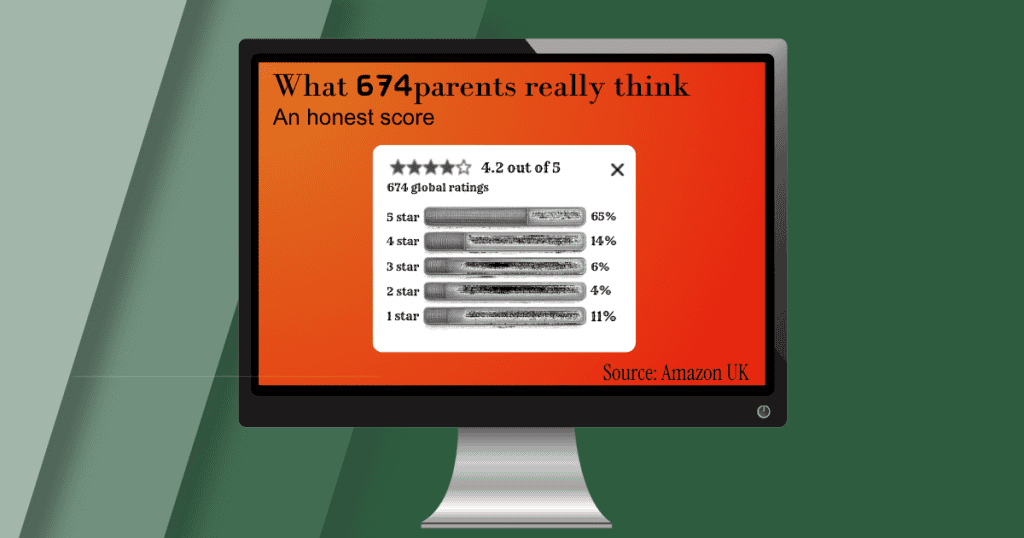
The honest news: 11% give it one star, and the complaints cluster around three things. Batteries that degrade until the unit lives on its charger. Units that develop faults or stop syncing. And that clicking or popping sound during charging that a handful of owners find irritating. None of this is unusual for a £60 electronics product — you’re seeing the normal spread of manufacturing quality at this price — but it’s why I’d buy from Amazon or another retailer with painless returns, test it hard in the first month, and keep the receipt.
One more thing the listing won’t volunteer: VTech sells a cheaper line called the LM808 (£41.49 for the single-camera version at the time of writing), and it sits right next to the VM3250 on the page looking like a bargain. Don’t. The LM808’s reviews are noticeably rougher: reports of batteries lasting a couple of hours, faulty parent screens, units refusing to sync even side by side, and a low-battery vibration alert that owners say wakes them more than the baby does — even when plugged in. The £18 you’d save is the difference between a monitor you forget about and a monitor you fight with. This is the rare case where the pricier VTech is the frugal choice.
VTech VM819 vs the Alternatives
No monitor is the best at everything. Here’s how the VM819 stacks up against what a UK parent will actually see on the shelf, with real prices at the time of writing.
| Monitor | Screen | Pan/Tilt | Battery (video) | Best for |
|---|---|---|---|---|
| VTech VM3250 (= VM819) | 2.8″ | No (manual) | Up to 19 hrs | Battery life, simplicity, privacy |
| VTech VM3250-2 (2 cameras) | 2.8″ | No (manual) | Up to 19 hrs | Two rooms — often cheaper than the single |
| VTech VM924 | 5″ | Yes (motorised) | Up to 17 hrs | Screen size + steerable camera |
| VTech LM808-1W | 2.8″ | No | Poor (owner reports) | Avoid — see above |
Now the honest bit that makes this table awkward. At its current deal price, the VM924 undercuts the VM3250 while offering a screen nearly twice the size and a camera you can steer from bed. It’s an Amazon’s Choice in its own right, rated 4.3 stars across 403 reviews, with over 700 bought in the past month. If both prices hold when you read this, the VM924 is the better buy for most families, full stop.
So why would you still pick the VM3250/VM819? Three real reasons. Battery: 19 hours versus the VM924’s 17 — and the smaller screen sips power, so the gap in practice is bigger than it looks. Zoom: 2x versus the VM924’s 1.33x — helpful when the camera can’t move. Two rooms on a budget: the VM3250-2 gives you two cameras for £54.49; the twin-camera VM924-2 is nearly double that at £100.31.
But prices are the moving part here. The VM924’s £50.99 is a limited-time deal; its regular price is £63.81, at which point the VM3250 at £59.99 — or the twin VM3250-2 at £54.49 — makes clean sense again. My genuinely practical advice: open both listings before you buy and let the day’s prices break the tie. Whichever way it falls, you’re getting a no-WiFi VTech, so the privacy case in this review applies to both.
And if the real problem is your walls, not your budget, none of these 2.4GHz monitors is the answer — a DECT monitor will beat all of them for reliability through solid brick. Start with our guide for Victorian houses before you spend a penny on video.
Where to Buy in the UK
The VM819 is easy to find once you know its UK name — but only in one place. All prices at the time of writing; Amazon moves them daily.
- Amazon UK — the single-camera VM3250 and the twin-camera VM3250-2, which is the one I’d jump on if you need two rooms covered. Worth knowing: Amazon offers 15% off when you buy through a baby wishlist, which takes the sting out further. At the time of writing, this is the reliable UK source.
- Boots, Argos, Tesco and Currys — none of these currently stock the VM3250 (or VM819) in their standard baby-monitor range. If you spot it listed elsewhere at a lower price, double-check the seller and the model number before you buy — a genuinely cheaper price from an unfamiliar third-party seller is more often a red flag than a bargain.
- John Lewis — also not in the standard range.
One final warning, short and simple: if you see a “VM819-2” listing on Amazon UK, it’s an American import that can arrive with US plugs. The UK twin-camera version is the VM3250-2. Buy that one.

FAQ
Does the VM819 need WiFi? Can it connect to my phone? No, and no — and that’s the point. The VM819/VM3250 has no WiFi, no app and no internet connection of any kind. It cannot connect to a phone, and no app exists for it. The camera and parent unit talk directly to each other over a closed 2.4GHz FHSS radio link. If you want phone viewing, this is the wrong monitor — but phone viewing is precisely the feature that gets monitors hacked and apps abandoned.
Why does the screen keep turning off — and how do I keep it on? That’s the sound-activated power-saving mode doing its job: the display sleeps to stretch the battery and wakes when the camera hears noise. If you want a constant picture, plug the parent unit into the mains and turn the video display on in the settings menu — the manual calls it disabling the screen timeout / enabling always-on video. Just know that always-on video unplugged will drain the battery far faster than the headline 19 hours.
Why is my VM819 not showing the temperature? The temperature reading comes from a sensor in the camera and has to be switched on in the parent unit’s menu — look for the temperature display option under settings. If it’s enabled and still blank or wildly wrong, re-pair the camera to the parent unit; if that fails, you’ve got a faulty sensor and it’s a returns job.
Can you add an extra camera, or buy the camera only? Yes — the parent unit supports up to two cameras, and VTech sells add-on cameras separately. But run the numbers first: at the time of writing the complete twin-camera VM3250-2 costs £54.49, which is less than the single-camera set plus a standalone add-on camera — and less than the single set full stop. If two rooms are even a maybe, buy the twin bundle now.
How long does the battery really last? Up to 19 hours of video or 29 hours of audio-only when new — genuinely the best in its class. Real-world use with the screen waking regularly lands lower, and UK owners’ long-term reports are mixed: many get years of solid unplugged use, while some find the battery fades until the unit needs to stay near its charger. Treat it like a phone battery: superb at first, gradually less so.
Is the VM819 secure from hacking? As secure as a baby monitor realistically gets for most families. Because it never connects to the internet, there is no app, cloud or account for a remote attacker to break into — the kind of intrusion that made headlines when a stranger’s sounds came through a family’s WiFi monitor in Colorado in 2025 simply can’t happen the same way here. No radio device is 100% impossible to intercept with specialist kit physically nearby, but a closed FHSS link removes the entire category of internet-based attacks. It also sits outside the UK’s PSTI Act — not because it dodges the rules, but because it has nothing connectable for the rules to apply to.
Is the VM819 the same as the VM3250? Yes. The VM819 is the US model name; the VM3250 is the identical monitor sold in the UK with a UK plug and UK warranty. Every spec — screen, range, battery, sensors — matches. Buy the VM3250 and you’ve bought the monitor every American review is talking about.
The Bottom Line
The VTech VM819 — the VM3250, once it lands in a UK basket — is the budget king without WiFi, and I mean that as real praise. For £59.99, or £54.49 with two cameras, you get class-leading battery life, dead-simple setup, and genuine privacy by design: no app to be abandoned like BT’s, no cloud account to be hacked, nothing that even falls under the PSTI Act because there’s nothing online to regulate. You pay for that with a small screen, average video, no remote pan or tilt, a battery that ages like every battery does, and 2.4GHz instead of DECT.
So here’s my honest, staged recommendation. Two kids or two rooms: the VM3250-2 — one of the best-value no-WiFi setups in the UK, especially when it’s priced below the single. One room, flat or newer house: the VM3250 — unless the VM924 is close in price when you check, in which case the bigger 5-inch screen and a camera you can steer from the parent unit win. Victorian or Edwardian house with solid brick walls: don’t fight physics — go DECT, starting with our Victorian houses guide. Tempted by the cheaper LM808: don’t be.
Whatever you choose, the principle I’d leave you with is the one I try to live by with all this stuff: buy the thing that does its job and gets out of your way. The monitor is not the point. The child in the next room is. For a lot of UK families, this monitor does exactly that — quietly, cheaply, and without ever asking for your WiFi password.
For the full range and how everything compares, start with our main guide to the best baby monitors in the UK. And keep an eye out — I’m putting together a dedicated round-up of the best budget baby monitors under £50, and this one will feature heavily.